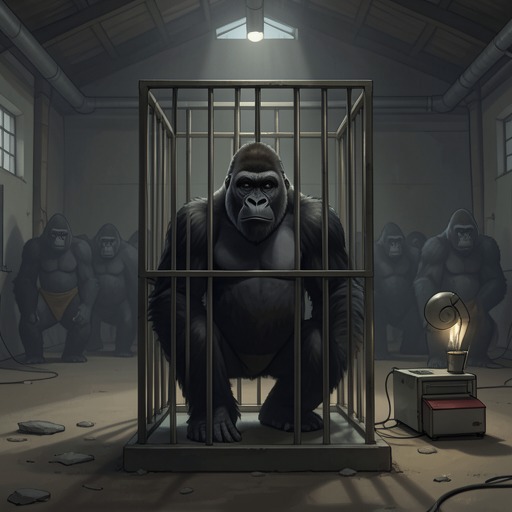
Ivan integrates into the zoo's gorilla troop
The One and Only IvanIvan’s integration into the zoo’s gorilla troop turns an open door into a difficult passage from solitary life toward companionship and responsibility. He has spent years without gorilla friends, watching a family on television before meeting one in person. At the threshold, he does not feel ready to become a silverback; acceptance comes gradually, through testing, imitation, play, and the quiet presence of Kinyani. The new life is real, but the wall that keeps the animals in remains visible.
From solitary watching to the threshold
At the Big Top Mall, Ivan describes his living space as his domain, but the word masks his isolation: he lives there because he is too much gorilla and not enough human, and he has no gorilla friends. Glass separates him from visitors who press their hands against it, making the division between human and animal seem permanent. His move toward a troop therefore means more than changing enclosures. It offers the possibility of contact with gorillas after a life organized around human spectators and a transparent barrier.
Before meeting the troop, Ivan watches a nature program without human voices or advertisements. Each day the screen shows a small, unusual family: three females and a juvenile male, with no silverback to protect them. He sees them groom, eat, sleep, play-fight, and bicker. These repeated images give him a view of gorillas living together, but watching is not the same as belonging. The troop is first present to him as a picture of ordinary shared life, observed from a distance.
The first door and the first refusal
The transition begins with a practical opening: Ivan’s cage door is propped open, and the giant box that had been moved against the doorway is open too. The arrangement makes the route out visible while also making the next step uncertain; beyond his door lies the humans’ box. Later, the humans lead him to another door. Kinyani and the other gorillas are waiting on the far side, making this second threshold the entrance to a social group rather than simply a passage out of his cage.
Ivan sees Kinyani as both terrifying and beautiful, and immediately feels the weight of what the meeting could require. He is not ready to be a silverback, and insists inwardly on his individual identity: Ivan, just Ivan. When the humans lead him to the troop, he decides that it is not a good day to socialize. The refusal is not the end of the attempt. Thinking of Ruby and imagining how readily she would have gone through the door helps him reconsider. When Maya asks whether he wants to try again, Ivan tells himself that it is time. The open door becomes a choice he can approach again, rather than a passage he must take all at once.
Kinyani’s test and Ivan’s display
On entering, Ivan sniffs, approaches, and struts, but the others do not welcome him. Their sharp teeth and loud voices make the group seem threatening, and he wonders whether he has done something wrong. Kinyani then chases him, throws a stick at him, and corners him. Ivan understands her actions as a test: she is assessing whether he is a true silverback capable of protecting her family. His first response is to cower and hide his eyes, an outward sign of the distance between the role expected of him and the confidence he feels.
A later encounter shifts the balance. When the juvenile male eyes Ivan’s food hungrily, Ivan imagines a different version of himself: his father’s son. He grumbles, swats, and swaggers, then beats his chest loudly. Moving toward the young male, Ivan makes him retreat. Kinyani and the others watch. The display does not establish that Ivan has mastered the silverback’s responsibilities, but it changes what the troop can see in him: he can answer a challenge with a show of strength, even while he is still trying on the role. The contrast with his earlier cowering makes this a small, consequential advance rather than a sudden transformation.
From wary contact to play
The first signs of acceptance are physical and tentative. Kinyani approaches, taps Ivan on the shoulder, and runs away on her knuckles. Ivan watches with his arms crossed and carefully makes no sound; he is not sure what they are doing. When she returns, shoves him, and dashes past, he recognizes the encounter as play. They are playing tag. The shift is modest in scale but decisive in kind: the same gorilla who had chased and cornered him now draws him into a shared game.
Ivan also begins to bring his past into the troop’s presence. He tells the others about Mack, Ruby, Bob, Stella, Julia, and George, as well as his mother, father, and sister. When he has finished, they look away in silence. The scene does not describe a spoken response or erase the distance between his former life and his new group. Instead, Kinyani moves closer; her shoulder brushes his, and they sit together in the sun. Their closeness offers a form of welcome without requiring the troop to explain itself in human terms. Ivan’s history remains his, but he is no longer alone with it.
Belonging within an enclosure
The troop’s presence changes Ivan’s social world: he moves from having no gorilla friends to playing with Kinyani and sharing quiet space beside her. Its effect is not simply that he has found company. The group’s earlier interactions have shown him the routines of family life, while Kinyani’s test confronts him with the protective role associated with a silverback. Ivan’s hesitant imitation of that role, followed by play and companionship, makes integration a process of learning how to act among others rather than a single moment of acceptance.
The zoo does not become freedom without limits. Exploring a hilltop, Ivan encounters an endless, clean white wall stretching beside habitats beyond his own. It is carefully built to keep the gorillas in and others out; he recognizes that this, too, is still a cage. The ending therefore holds two facts together. The zoo gives Ivan access to a troop, outdoor space, and new relationships, but its boundary still governs where he can go. Integration changes the life lived inside that boundary without making the boundary disappear.